
The dopamine loop behind every AI prompt

I needed a toilet break an hour ago. I still haven’t taken it.
It started with one edge case to check before stepping away. I asked the AI for a quick fix. The output was almost right, so I tweaked the prompt. The next suggestion was better, but not quite. Tests pass. Something moves. One more adjustment.
I haven’t made a decision in twenty minutes. I’ve been responding. Code appeared, choices were made, but I don’t remember making most of them. I kept going. I never decided to stop.
The cycle restarted before I chose to continue it. I didn’t enter the loop deliberately. I was already in it.
Behavioral science has a name for that pattern: a habit loop built on cue, routine, and reward. And the brain has a mechanism that keeps it spinning. Dopamine, the signal that fires every time an outcome surprises you. AI coding tools produce output that is hard to predict. That combination compresses the habit loop into something that runs before you choose to enter it. The cost isn’t the code; that still gets written. The cost is that you stop choosing when to start.
The mechanism is worth naming. Five practices at the end put a deliberate choice back in front of every prompt.
Why Prompting Feels Like Progress
Dopamine isn’t a pleasure chemical. That’s the pop-psychology version.
Dopamine is a learning signal. It fires in response to reward prediction errors (RPE), the gap between what you expected and what you got [1]. When something turns out better than expected, dopamine activity spikes. When it turns out worse, it suppresses. When it’s exactly what you predicted, nothing happens. The brain tracks surprise, not pleasure.
That distinction matters because unpredictability amplifies the signal. You get the strongest dopamine response not when a reward arrives, but when it might arrive and you don’t yet know if it will [2]. Every time you hit Enter on a prompt, you’re generating exactly that uncertainty. The output could be perfect, useless, or surprisingly close. Your brain registers that unpredictability before you’ve read the first line.
The same system drives curiosity, persistence, the pull to understand something you don’t yet grasp [3]. Every deep debugging session that eventually clicks; that’s dopamine working as designed. That signal keeps you with a problem long enough to crack it.
But the mechanism doesn’t distinguish between sources of surprise. The prediction-error signal responds to the structure of the feedback, not who or what produced it [1]. A hard-won insight and an unexpectedly good AI suggestion trigger a similar signal. Both strengthen the routine that preceded them. The difference is which routine gets strengthened: your own thinking, or the act of prompting.
A well-rewarded behavior wants to repeat. In gambling disorder and gaming disorder (formally recognized conditions [4]), researchers describe craving: the pull toward a behavior before the reward arrives. In a developer context, that looks like reaching for Copilot before you’ve thought through the problem, or feeling restless when a long build cycle leaves nothing happening for two minutes. The comparison is a lens, not a diagnosis. It’s useful for understanding what happens next.
Two Loops, Same Brain
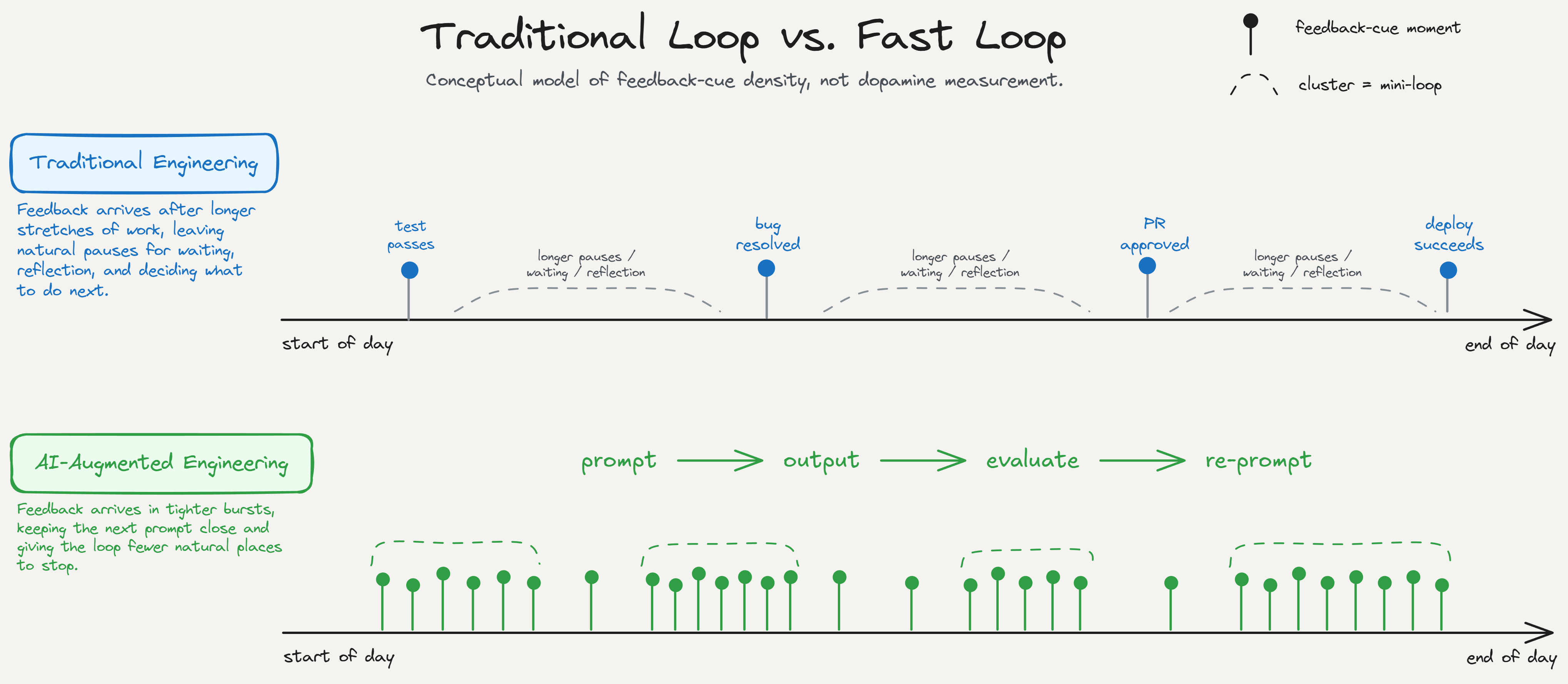
Traditional software engineering has a wide loop. The trigger is concrete: a failing test, a compiler error, a design problem that doesn’t resolve on paper. The work is deliberate and extended. Progress arrives sparsely. The test suite goes green after a long chase, the bug finally resolves, the PR merges cleanly. Engineers spend roughly as much time waiting for builds and tests as writing code [5]. Those gaps are natural interruption points where the loop pauses long enough that you stay aware you’re in it.
The rewards are strong precisely because the uncertainty was real. You couldn’t have known when or whether the resolution would come. The prediction-error signal fires hard, and the brain encodes something lasting: “I held this problem, I thought it through, I made something work.”
The AI-augmented loop has a different shape. This is the fast loop: any moment of friction triggers a prompt, the output arrives in seconds, and the result generates a new prompt before you’ve consciously decided to continue. A randomized controlled trial found developers accepted roughly one in three Copilot completions [6]. Across a typical session, that means dozens of accept-or-reject micro-cycles complete every hour. A compiler fires once when you’re done. AI fires continuously while you work.
What makes this especially effective at sustaining the reward signal is the non-determinism. A compiler is deterministic; your brain quickly learns to predict the output, and the prediction-error signal fades. An LLM samples from a probability distribution. The same prompt produces different outputs on different runs. Understanding how LLMs work doesn’t make any specific output predictable, so the prediction-error signal keeps firing run after run. Uncertainty about whether a reward will arrive amplifies that signal, making uncertain cues more compelling than predictable ones [2]. Combine that with high frequency and fast resolution, and you get a pattern that structurally resembles reward schedules associated with habit formation [7].
The fast loop isn’t inherently harmful. It helps you explore options you wouldn’t have time to generate manually, get unstuck from unfamiliar territory faster, and scaffold your thinking when learning something new. A prompt like “what patterns exist for handling this kind of stateful problem?” can open a learning path that would have taken days to find on your own. The fast loop is a genuine productivity tool when you’re directing it. That means you chose to enter it, and you defined the problem before the first prompt.
The problem starts when the loop runs without that choice.
When the Tool Starts Using You
The strange part is that nothing feels wrong while it happens. You still look productive. The IDE changes. The diff grows. The test output scrolls by. From the outside, this is work. From the inside, it is closer to chasing the next almost-right answer.
A behavior that gets rewarded often enough changes character. At first, the trigger is obvious: I’m genuinely stuck, the problem is hard, I don’t know where to start. I open the tool deliberately, formulate a real question, evaluate the response with care.
Over time, the threshold lowers. A vague sense of friction becomes enough. The blank function body at the top of a new file becomes enough. A slow build becomes enough. The tool opens before a real question has formed. Psychologists call this automaticity: a behavior that was once deliberate, triggered by context rather than conscious decision [8].
That shift is invisible in the moment because AI does accelerate. Controlled trials found significant productivity gains on unfamiliar code [9]. For getting oriented, scaffolding, or bridging knowledge gaps, the fast loop earns its name.
But a 2025 pre-registered trial measured what happens on familiar code. Sixteen experienced open-source developers got tasks on codebases where they had, on average, five years of prior experience. Half the tasks allowed modern agentic tools (Cursor Pro with Claude 3.5 and 3.7 Sonnet); half didn’t. Tasks completed with AI took 19% longer than tasks completed without it. The developers themselves had predicted AI would make them 24% faster [10].
They felt faster. They weren’t.
On familiar problems, the faster path was to think. But prompting felt more active, lower-effort to enter, and more immediately rewarding than sitting with a problem they already knew how to approach. The signal from an almost-useful suggestion registers as forward momentum even when it isn’t. The easier-feeling path replaced the more effective one without the developer noticing.
Agentic tools extend this further. With traditional tooling, a break is a break. The compiler doesn’t run during your coffee; the test suite waits while you’re in a meeting. With an agentic tool, the loop doesn’t pause. I’ve caught myself launching an agent right before leaving my desk, not because the task was urgent, but because walking away without something running felt like leaving progress on the table. That pull isn’t efficiency reasoning. The agent hasn’t started yet; nothing has been lost. It’s anticipatory craving [2]: the brain orients toward the possible reward before a decision is made. Not starting feels like declining a reward already within reach.
There’s a name for this pattern: the paradox of generative AI dependence [11]. The more useful the tool, the more invisible the dependency. The habit forms precisely because the tool works, which is exactly what makes it hard to notice where “using a good tool” becomes “needing the tool to function”.
The code still gets written either way. The understanding doesn’t. That gap is what comes back the next time something breaks.
Breaking the dopamine loop
You can’t quit a tool that works. And unlike gambling disorder or gaming disorder, the answer here isn’t abstinence [4]. AI acceleration is real; using it is part of the job. The difficulty is that the same usefulness that makes the tool valuable is what makes the habit invisible.
You don’t fight a habit loop with willpower. You redesign it.
1. Write the question before you open the tool. Before the first prompt, write one sentence: “I’m trying to understand why this service degrades under load.” Not a task description, a problem statement. If you can’t articulate it, the loop is already ahead of you. The sentence doesn’t prevent AI use. It makes the automatic part visible.
2. Set a timer. Start a 25-minute Pomodoro timer [12]. Traditional workflows had natural stopping points (a compiler run, a test suite, a deploy pipeline), but AI removed those interruptions. The fast loop keeps running as long as output keeps arriving, which is always. The timer reintroduces a boundary where you can choose. When it rings, check: are you still solving the original problem, or did the output carry you somewhere adjacent?
3. Name the reason before launching an agent. Running an agent async while you step away could genuinely be efficient when the task is long and you’ve defined what done looks like. The signal to watch for is the opposite case: launching because walking away without something running feels wrong. Ask yourself once: what will I review when I get back? If the answer is fuzzy, the motivation probably isn’t efficiency.
4. Review reasoning, not only code. When AI writes much of the code, working tests are a weak signal. AI makes working code easy to produce. The harder output is code the team can still read, modify, and debug six months later. Frame code reviews around one question: can you explain why this approach over the alternatives?. A PR where the diff is clean but nobody can explain a single decision is a sign that movement substituted for thinking. Require PR descriptions to include at least one rejected alternative and why.
5. Notice the discomfort. Can you choose not to prompt when the problem is hard? Not as a rule, as an option. If that question produces discomfort, if not prompting feels like leaving capability on the table you weren’t sure you still had, that discomfort is data about how automatic the routine has become. You open the chat window before you’ve formed a question. You accept output you haven’t fully read. You feel friction when the tool is slow. Those are the signals.
The Loop and the Choice
The fast loop doesn’t run because you decided to use AI. It runs because that’s what any well-rewarded behavior does: once the pattern has been reinforced often enough, it continues until something interrupts it. Not a character flaw, not a discipline problem. A structural property of a loop that can outrun conscious choice.
The risk is not that developers use AI. The risk is that the loop starts before deliberate choice enters. The five practices above redesign that loop: make the trigger visible so reaching for the tool stops being automatic, create a pause so you can redirect, shift what counts as progress from output to understanding. Each one protects the slower, deliberate work where judgment actually forms. Not by removing AI, but by creating the conditions where using it is still a choice.
The difference doesn’t show up in your git log. It shows up in whether you understand what you built, and whether you could build it again without the tool. Remember the toilet break you still haven’t taken? Before every session: what am I actually trying to solve? If you can’t write that sentence, the loop is already running.
References
[1] Kahnt, T. & Schoenbaum, G., “The curious case of dopaminergic prediction errors and learning associative information beyond value,” Nature Reviews Neuroscience 26(3), 2025.
[2] Robinson, T.E. & Berridge, K.C., “The Incentive-Sensitization Theory of Addiction 30 Years On,” Annual Review of Psychology 76, 2025.
[3] Poh, J.-H. & Adcock, R.A., “Motivation as Neural Context for Adaptive Learning and Memory Formation,” Annual Review of Psychology 77, 2026.
[4] APA, Diagnostic and Statistical Manual of Mental Disorders, Fifth Edition (DSM-5), American Psychiatric Association, 2013; WHO, ICD-11 for Mortality and Morbidity Statistics, “6C51 Gaming disorder”, World Health Organization, 2019.
[5] Shani, I. & GitHub Staff, “Survey reveals AI’s impact on the developer experience,” GitHub Blog, 2023.
[6] Gao, Y. & GitHub Customer Research, “Research: Quantifying GitHub Copilot’s impact in the enterprise with Accenture,” GitHub Blog, 2024. Randomized controlled trial.
[7] Clark, L. & Zack, M., “Reward variability and frequency as prerequisites of behavioral addiction,” Addictive Behaviors, 2023.
[8] Wood, W. & Rünger, D., “Psychology of Habit,” Annual Review of Psychology 67, 2016.
[9] Peng, S. et al., “The impact of AI on developer productivity: Evidence from GitHub Copilot,” arXiv:2302.06590, 2023.
[10] Becker, J. et al., “Measuring the impact of early-2025 AI on experienced open-source developer productivity,” arXiv:2507.09089, 2025. Pre-registered randomized controlled trial, 16 developers, 246 tasks.
[11] Liu, J., “When usefulness fuels fear: The paradox of generative AI dependence and the mitigating role of AI literacy,” International Journal of Human-Computer Interaction, 2026.
[12] Cirillo, F., The Pomodoro Technique, FC Garage, 2006.